The A- Team
Want to know what really makes our team tick? We try our best to operate via explicit policies, and now we’re also making them public, so that others can verify what we do, give us feedback and all work together to a better A-Team! Check out the info below:
EMPLOYEE DEVELOPMENT, PORTER WELFARE AND ENVIRONMENTAL STEWARDSHIP STATEMENT
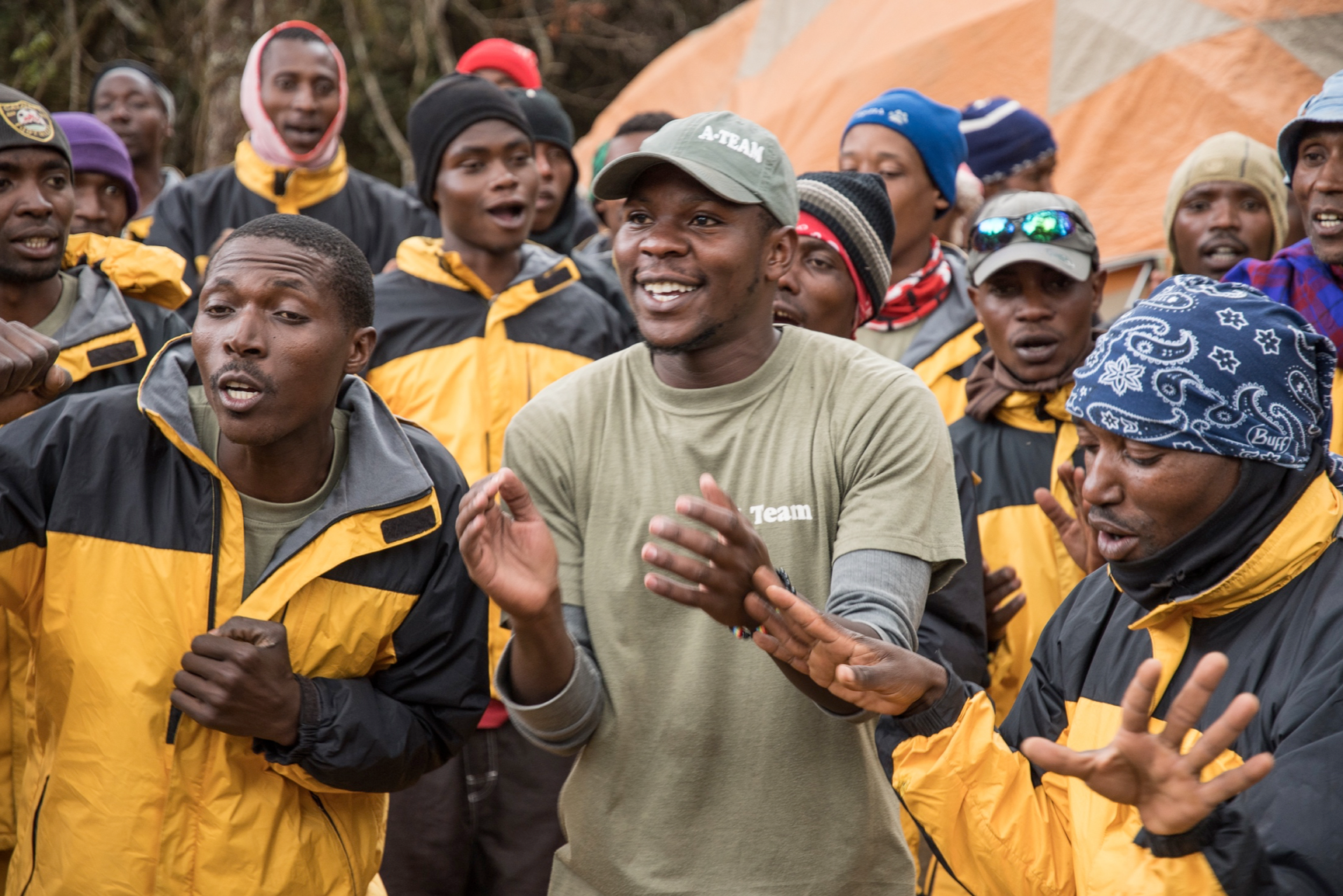
Since its establishment in 2007, Summits Africa Ltd has maintained a long-term commitment to developing tourism professionals, supporting employee welfare, promoting fair employment practices and protecting the environments in which we operate.
We believe that exceptional guest experiences are only possible when employees are treated fairly, provided with opportunities for growth, and empowered through continuous education and training. Equally, we recognise our responsibility to protect the mountain and wilderness environments that form the foundation of our operations.
EMPLOYMENT PHILOSOPHY
Summits Africa is committed to creating long-term career opportunities within Tanzania’s tourism industry. Wherever possible, we seek to recruit locally, develop talent internally and promote employees based on demonstrated ability, character, commitment and professional growth.
Many members of our office, operational and guiding teams began their careers in entry-level positions within the company and have progressed through structured training, mentorship and practical experience.
We expect our best guides to remain on, as instructors.
Examples of internal career progression include:
• Porters progressing into operational and administrative roles.
• Drivers progressing into management positions.
• Support staff transitioning into specialist technical roles.
• Crew members developing into cooks, guides and senior leadership positions.
• Employees applying skills developed within tourism to broader professional and community opportunities.
We actively encourage employees to pursue further education and professional development and provide both financial and operational support wherever practical.
BI-ANNUAL TRAINING PROGRAM
A cornerstone of Summits Africa’s culture is its commitment to structured training. Since 2007, the company has maintained a programme of bi-annual staff training designed to improve professional standards, safety, welfare, communication and leadership.
All crew members are encouraged to participate in a series of foundational courses that provide both workplace and life skills (the we provide free of charge to participants).
These core courses include:
HIV/AIDS Awareness
Money Management and Financial Literacy
Community Based First Aid (Swahili)
Human Rights Awareness
English Language Development
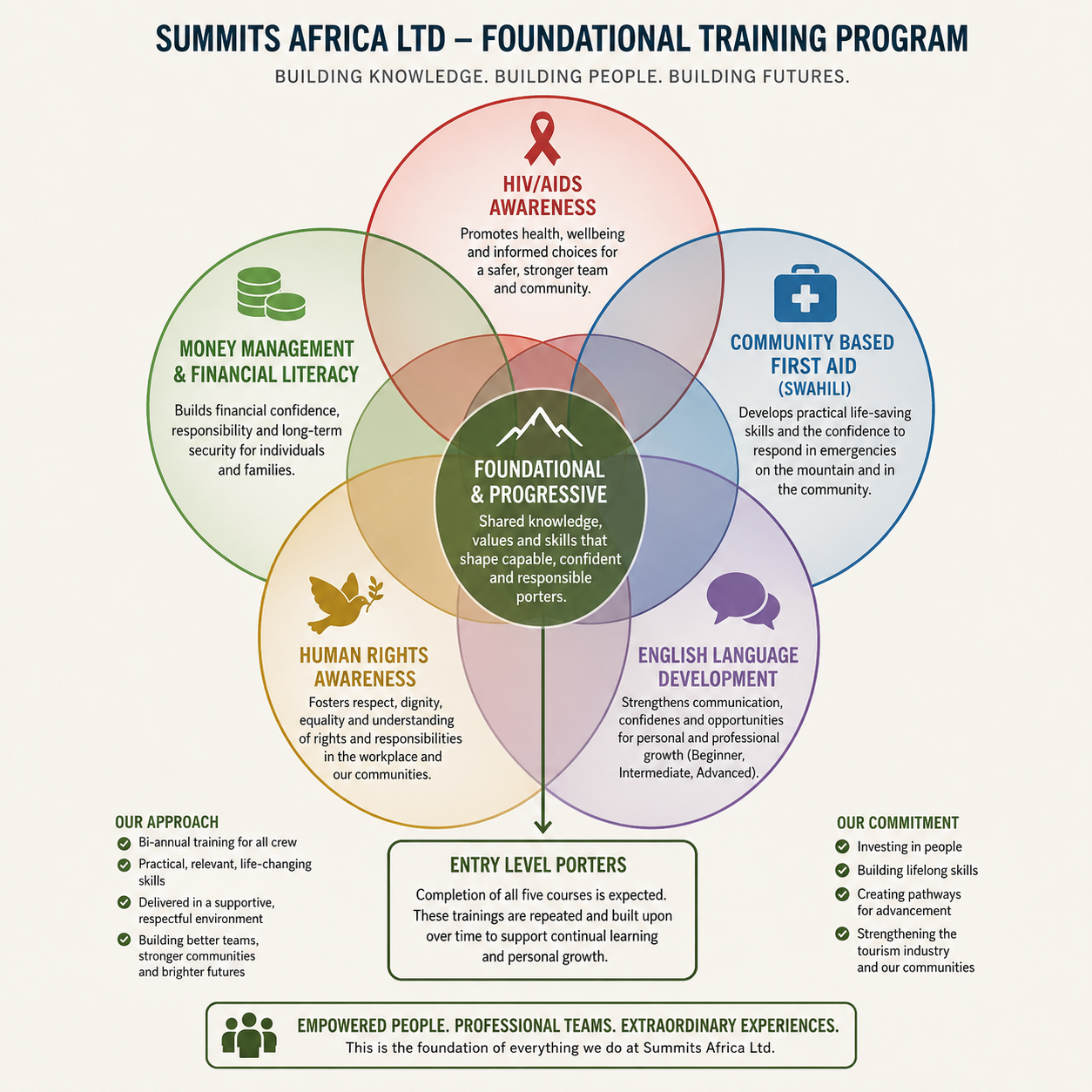
English language training is delivered at Beginner, Intermediate and Advanced levels, allowing employees to continue progressing throughout their careers.
First Aid and English training are regularly repeated and updated to reinforce skills and encourage continued development.
PORTER DEVELOPMENT PATHWAY
Summits Africa maintains a structured pathway for individuals seeking employment on Kilimanjaro expeditions.
New entrants are generally required to begin through resupply and support work. This allows the company to assess reliability, work ethic, teamwork, physical capability and character before individuals are placed on the active mountain crew roster (currently we have approx 400 porters on our roster to give you a scale of the numbers we impact).
Following successful participation in support roles, crew members are encouraged to complete the company’s foundational training programme.
This approach helps ensure that all personnel entering the mountain environment understand:
• Professional conduct
• Teamwork and leadership
• Health and safety principles
• Human rights standards
• Financial responsibility
• Effective communication
The company believes this pathway provides both fair opportunity and a strong foundation for future career progression.
GUIDE DEVELOPMENT AND PROFESSIONAL ADVANCEMENT
The development of professional mountain guides is a long-term investment requiring years of practical experience, education and mentorship.
Employees wishing to pursue guiding careers undertake additional development through:
• Informal field mentoring and instruction.
• Structured educational programmes.
• Specialist wildlife and environmental training.
• Interpretation and communication skills development.
• Safety and risk management training.
Training topics may include:
• Animal behaviour
• Birds
• Snakes and reptiles
• Ecology
• Geology
• Mountain environments
• Cultural interpretation
• Client care and leadership
Employees progressing toward guiding careers are supported in obtaining the necessary qualifications and licensing requirements established by the relevant authorities.
WILDERNESS FIRST RESPONDER TRAINING
Summits Africa places particular emphasis on safety leadership.
Wilderness First Responder (WFR) training is provided to trainee guides, assistant guides and head guides as part of a progressive development pathway.
Once a guide has obtained the appropriate guiding licence from Kilimanjaro National Park and demonstrated sufficient experience and competence, they may begin operating as a trainee guide.
Progression through the guiding structure typically requires significant practical experience. Assistant guide positions generally require a minimum of two years of guiding experience, while progression to head guide level commonly takes six years or more of demonstrated field performance and leadership.
PORTER WELFARE COMMITMENT
Summits Africa is committed to maintaining high standards of porter welfare throughout all mountain operations.
Every expedition includes dedicated systems for monitoring the health, welfare and working conditions of porters and crew members.
These systems include:
• Crew welfare monitoring.
• Health reporting procedures.
• Equipment inspections.
• Food provision monitoring.
• Accommodation monitoring.
• Post-climb reporting and review.
To ensure we can perform each of these tasks each and EVERY trip has documentation to ensure that at each stage, through trip preparation, guest management, on mountain expedition and post trip feedback are all part of a CLOSED LOOP SYSTEM, such that each feeds into the other and at the end the reporting may impact SYSYEM CHANGE if approved by management, thereby impacting all future trips.
The company is independently monitored and audited through the KilimanjaroResponsible Travel Organisation (KRTO, also known as KPAP)
These audits assess numerous welfare indicators, including:
• Fair treatment of crew.
• Adequacy of food provided.
• Transparency of tipping procedures.
• Sleeping conditions.
• Equipment standards.
• Wage payment practices.
• Timeliness of payment following expeditions.
You can read more about KRTO here.
Summits Africa views independent oversight as an important mechanism for maintaining accountability and continually improving standards. In other words we love being independently audited on all aspects of our operation, most of all our treatment of porters and crew!
HUMAN RIGHTS AND FAIR TREATMENT
Respect for human dignity forms a core principle of the company.
Human rights awareness training is included within the foundational training programme and applies to all employees regardless of position.
Summits Africa is committed to:
• Equal opportunity.
• Non-discrimination.
• Respectful treatment of all employees.
• Safe working environments.
• Fair compensation practices.
• Transparent communication.
ENVIRONMENTAL RESPONSIBILITY AND LEAVE NO TRACE
Summits Africa recognises that tourism activities must contribute to the long-term protection of the environments in which they operate.
All guides receive environmental awareness training and instruction in Leave No Trace principles.
This training is frequently delivered in conjunction with Wilderness First Responder courses, although dedicated environmental training sessions are also conducted separately.
Environmental training focuses on:
• Waste minimisation.
• Responsible campsite management.
• Protection of water sources.
• Respect for wildlife.
• Minimising trail impacts.
• Responsible visitor behaviour.
• Conservation leadership.
Guides are expected to model these behaviours and communicate environmental responsibilities to clients throughout every expedition.
CONTINUOUS IMPROVEMENT
Summits Africa views employee development, welfare and environmental stewardship as ongoing responsibilities rather than fixed achievements.
Through regular training, independent auditing, career development opportunities and continuous review of operational practices, the company remains committed to strengthening both the tourism industry and the communities and environments upon which it depends.
Approved by: Summits Africa Ltd - June 2026